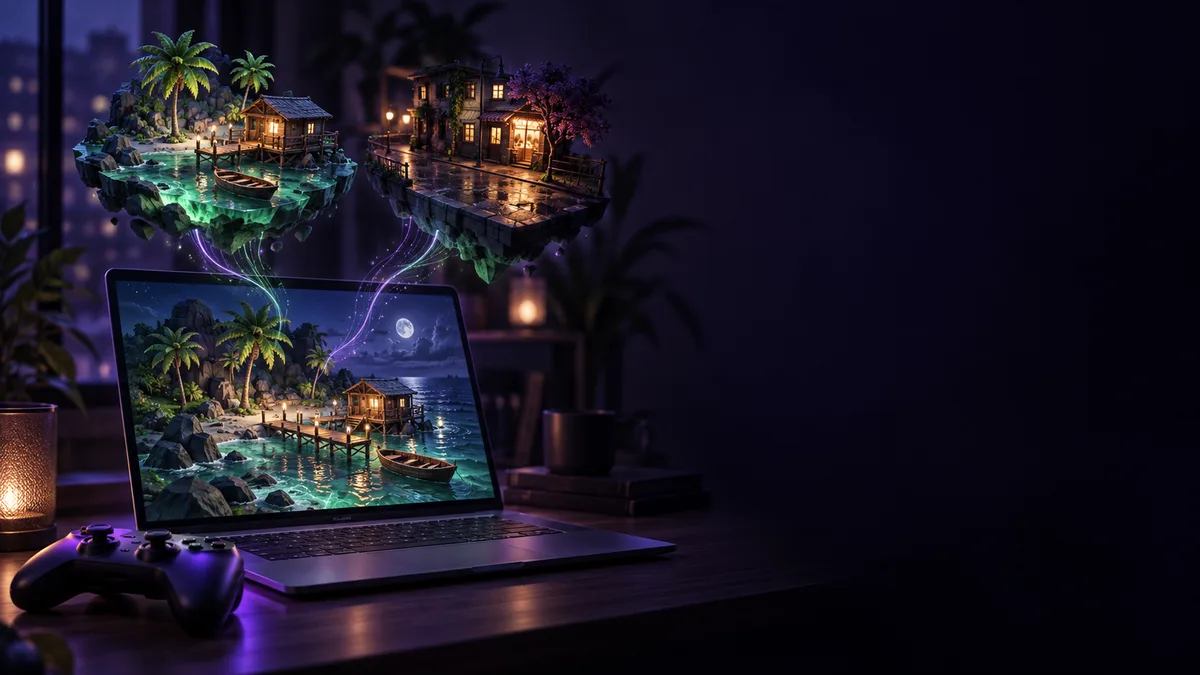
An island, palms, a pier, a boat, a fishing hut, modeled in Blender by the AI; walking, casting, bait, catching, day and night, added one layer at a time 1 2. A recipe for having an AI agent build a fishing game like that has been posted.
rewind02 wrote up how to build a game like this with Claude Opus 5.5, Blender and Unity 6, as a series of steps 3.
This time we did not just read; we also tried one ourselves. A post says a rainy-night convenience store game was made from 3 sentences 11. We gave Opus 5.5 3 sentences that we wrote ourselves, and in about 14.9 minutes we had a three.js game you can run around in with the keyboard. The sign's lettering showed up upside down in the puddles, but up close the girl was a doll. We describe in detail later on what it reached and where it stopped.
A note up front. Our test machine is a desktop PC with a single GeForce RTX 5060 Ti 16GB, not an RTX Spark machine. Nothing in our measurements in this article tells you how things run, or how fast, on RTX Spark.
here's how to build a game like this with Claude Opus 5.5 + Blender + Unity 6...
— rewind (@rewind02) October 10, 2026
the trick is preparing everything before Opus writes a single line, but there's a smart way to set it up:
- step 1: connect Claude Code to Unity and Blender through MCP
- step 2: write one big… https://t.co/yMExa4WFO6 pic.twitter.com/WZZ3Sqt1Q8
Build the island, play it, fix it
Here are the steps, in the poster's own words.
- Step 1: connect Claude Code to Unity and Blender through MCP 28
- Step 2: write a big brief covering the world, the mechanics, the UI and the mood, plus reference images 29
- Step 3: add a CLAUDE.md with your rules, and design docs as the single source of truth, so Opus never has to guess 30
- Step 4: split the work among subagents (design, modeling, textures, and a reviewer that only looks and approves) 31
- Step 5: Opus models the assets in Blender: the island, palms, pier, boat and fishing hut 1
- Step 6: it builds a greybox in Unity first, plays it, fixes it, and repeats 27
- Step 7: add mechanics a layer at a time: walking, casting, bait, catching, day and night 2
- Step 8: a person watches and gives feedback with a reason, such as "too dark at dusk" or "cut the water stripes" 6
What stands out is the order. The trick, the poster writes, is preparing everything before Opus writes a single line 4. Don't ask for the game first. Get the brief and the source of truth in place, then let the building hand move.
Then come the rules that make it work. The agent that builds is never the one that approves, and every fix gets written into a file so the next project starts smarter 5. It points the same way as step 8, where feedback comes with a reason 6.
And start small. A fishing game, the poster says, is the perfect first project 7.
We have not tried this Unity recipe. In steps 6 and 8, a person is inside the play-and-fix loop, watching and giving reasons. Our convenience store reproduction, described below, was the opposite on that point. No human check was inserted; the agent looked at the screen itself and fixed things itself.
From photos and a floor plan to a 3D Airbnb
The raw material for a world doesn't have to be imagined. SimbasJungles writes (in Portuguese) that they sent some base photos and a 2D floor plan, plus references from Pinterest, and asked for a 3D world built with Blender and Unreal Engine 5 8. The post opens "Eu modelei meu Airbnb inteiro com Opus 5.5," which translates as: I modeled my whole Airbnb with Opus 5.5 9.
Eu modelei meu Airbnb inteiro com Opus 5.5
— Simba (@SimbasJungles) October 11, 2026
Enviei algumas fotos base e a planta 2D, somado com algumas referências do Pinterest, e pedi pra criar um mundo 3D usando Blender e Unreal Engine 5. pic.twitter.com/uugUmelEwV
Photos and a floor plan were the raw material for the request 8. It runs the opposite way from an imagined island: building a world from something real at hand. We have not tried this example either.
Open a browser tab, and you're in the world
Some examples put the world in a browser with three.js. A quick tour.
anxuanng writes that Opus 5.5 built every asset in Blender and this whole three.js scene in 76 minutes, with no hand edits 10. The timing and the lack of edits are the creator's own claims.
Not just After Effects
— An Xuan (@anxuanng) October 11, 2026
Opus 5.5 built every asset in Blender and this whole three.js scene in 76 minutes, no hand edits https://t.co/qTLN16sim1 pic.twitter.com/uqYPcIQcVj
NFT_Chen (in a Chinese-language post) writes that a rainy-night convenience store game came out of 3 sentences of prompt to Opus 5.5 plus three.js 11. The creator points to the inside and outside of a Japanese convenience store on a rainy night, reflections in puddles, streaks of rain, and the contrast between warm light and cold blue 12. A girl with long hair runs holding a clear umbrella, the post adds 13.
🔥绝了!用Opus 5.5 三句话 + Three.js 直出高质感雨夜便利店游戏!
— SuSu_酥酥👅 (@NFT_Chen) October 10, 2026
氛围感拉满,正式版动作和细节已经很接近真人了。
关键细节:
🔸雨夜日本便利店内外场景,积水倒影、雨丝、暖光与冷蓝对比强烈
🔸长发少女持透明伞奔跑,步伐和身体动作流畅自然… pic.twitter.com/t19vInJ6Oq
We had it built from 3 sentences on our own machine
Are "3 sentences" really enough? We decided to reproduce this example on our own machine.
The original post's 3 sentences, however, are not public. So we wrote the following 3 sentences ourselves, based on the highlights described in the post (our translation).
- "Using Three.js, make a small game where you run in front of a Japanese convenience store on a rainy night."
- "I want to show reflections in puddles, streaks of rain, and the contrast between the warm light inside the store and the cold blue outside."
- "The main character is a girl with long hair holding a clear umbrella, and I want to be able to make her run with the keyboard."
We passed these to Opus 5.5 as they were. Apart from the prompt, we gave no instructions about direction or look. All we added were the experiment's conditions: where to put the work, recording the time, and not installing new software. Opus 5.5 ran as a subagent on Claude Code, so the thinking side was in the cloud.
The result: a three.js game in about 14.9 minutes. The code is 1,075 lines and uses no external assets. After checking that it ran, there were 3 rounds of fixes. The camera was too far and the girl too dark; the area around the store was blown out to white; the hair was too thin and the umbrella too high. The agent found these 3 itself by looking at the headless screen, and fixed them itself. We gave no instructions at this stage.
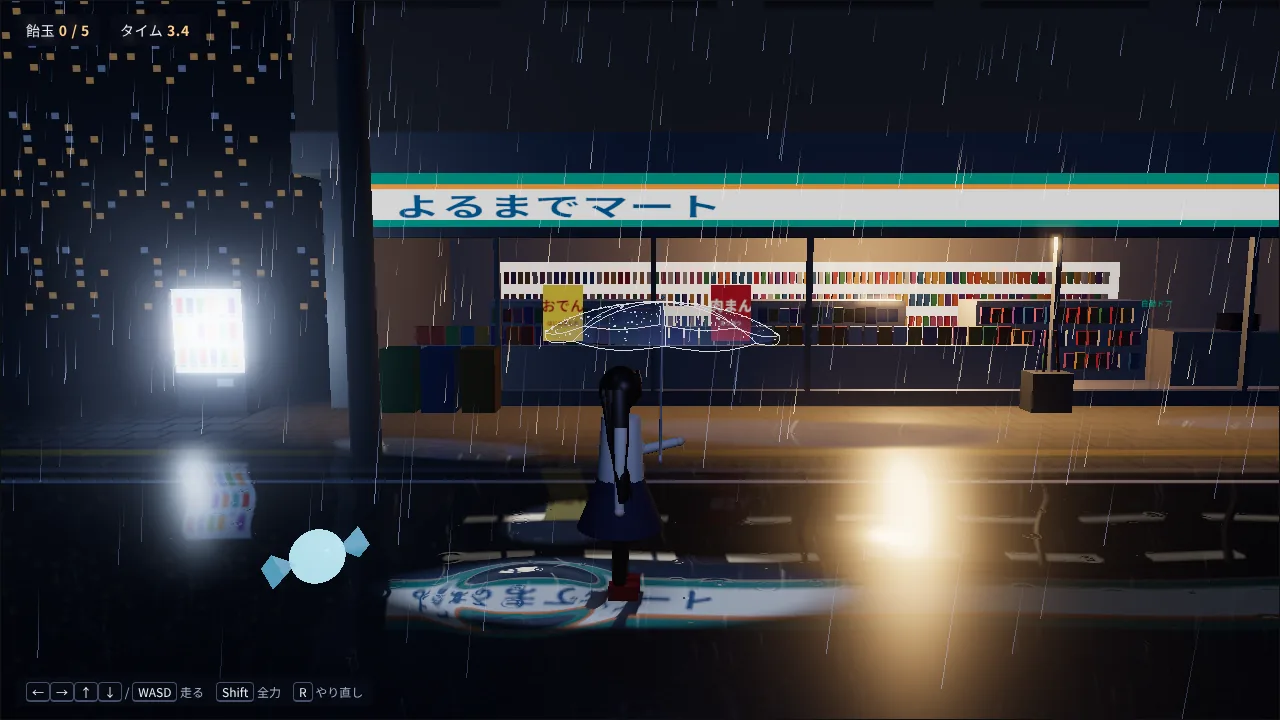
First, what it reached. The sign's lettering is reflected upside down in the puddles. The warm colors inside the store face the blue outside. Streaks of rain appeared in all 4 screenshots we looked at. There is a girl with a clear umbrella and long hair. You can make her run with the keyboard: arrow keys or WASD, with Shift for a full sprint. In the running shots, rings of ripples show up in the puddle at the girl's feet. Without a word about it in the 3 sentences, it even came with a goal: pick up 5 candies and enter the store to clear the game. The highlights listed in the prompt (reflections, streaks of rain, warm light and cold blue, the girl with a clear umbrella and long hair, keyboard control) all made it onto the screen in some form.
What it did not reach is just as clear. The girl's body is a combination of cylinders and spheres, and her face is just dots for eyes. Up close, she is a doll. The puddle reflections are a flat mirror, with no depth to the water surface. We did not confirm splashes when running in the images. This is not the same thing as the poster's video; what we got is strictly our version, born from our 3 sentences.
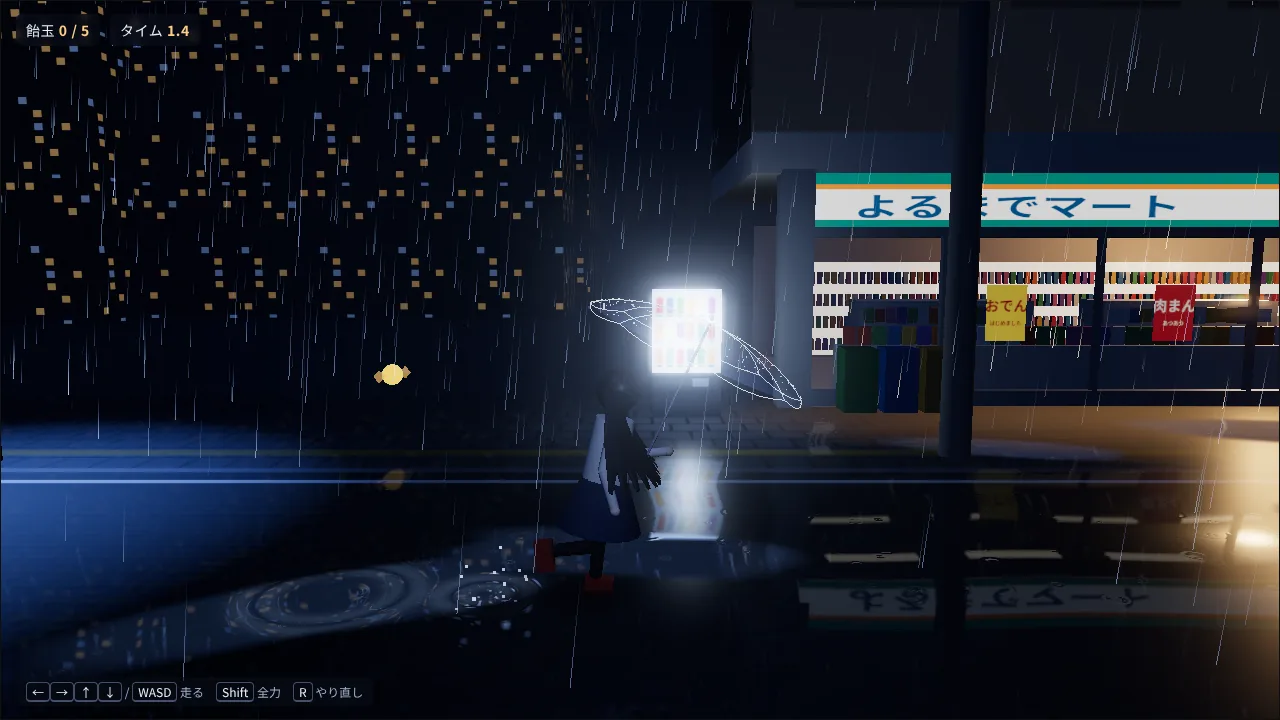
anxuanng's "76 minutes, no hand edits" mentioned above and our "about 14.9 minutes, 3 rounds of fixes" differ in subject and scale, so they cannot be compared. What we can say side by side is this: from a short prompt of 3 sentences came a game with rain, light, reflections and controls all in place, and after it ran, the agent fixed it 3 times on its own.
We did not check how smoothly the screen moves this time. The screenshots were taken with headless rendering that does not use the GPU, not as a measurement of how it runs on our GPU.
Other three.js examples
ai_growth_avii writes that Opus 5.5 made a drone racing game, using just three.js, in the browser 14.
Opus 5.5 made a drone racing game...
— Avi Yadav (@ai_growth_avii) October 11, 2026
just Three.js. in the browser 🫡
Link to play is in the comments 👇🏻 pic.twitter.com/ebijx3cWIM
akakuma0219's "Yuuyake Roji" (Sunset Alley) is a miniature world that takes in an illustration and moves with simple animation, according to its creator, who wrote in Japanese 15. The illustration prompt was only a single line, which translates as "a Showa-era downtown, in a watercolor anime illustration style," and Opus 5.5 made the result, animation included, the creator writes 16. One line of prompt in, a miniature world out.
Opus5.5 × Three.js
— あかくま屋 (@akakuma0219) October 2, 2026
『ゆうやけ路地』
今回はイラストを取り込んで簡単なアニメーションで動く箱庭世界を作ってみました。
イラスト指示は、
「昭和の下町で水彩画アニメイラスト風でお願い」
のみで、アニメーションも含めてOpus5.5が作ってくれてます。… https://t.co/j1GzdZ7cHA pic.twitter.com/D2RGSsQrgr
chetanankola's "Cozy creek" is a three.js 3D experience of a creek. The creator says it was made with GPT 6 Astra and runs in a browser 17, and that everything was made in Blender 18.
Cozy creek - threejs 3D experience of a Creek made in GPT 6 Astra
— Chetan Ankola (@chetanankola) October 8, 2026
This is running in a browser! can you believe it!
all thing made in blender.. pic.twitter.com/iebiqV0QmV
Blender for the assets, three.js to put them in a browser. That pairing came up back to back, which caught our eye 10 18. Our reproduction used no external assets; every shape was built inside the three.js code. We did not try how things would change with a step of making assets in Blender.
If you want to do it at your own desk
First, a map of what is local and what is cloud.
For Opus 5.5, the official page lists the Claude Platform and Amazon Web Services as where it is available 19. Claude Code's CLI runs on your machine, but the model needs an internet connection 20. Claude Code does ship a win32-arm64 build 21. In our reproduction too, Opus 5.5, the thinking side, ran in the cloud.
The tools that build the world, such as Unity and Blender, are what you can run locally.
- The Unity 6 editor lists Windows 11 on Arm64 in its official system requirements 32. It assumes workstations and laptops running without emulation 33. A free version, Unity Personal, is available 34.
- Blender's official download page says it is compatible with Windows on Arm 35.
- three.js is released under the MIT License 36.
In our reproduction, the thinking side was in the cloud, and what remained locally was 1,075 lines of code with no external assets. The agent ran it, checked it and fixed it on its own, so our job was writing 3 sentences and looking at what came out. On the other hand, we did not measure how much load it put on the local GPU or memory this time. We also have not tried the approach in rewind02's steps of keeping Unity and Blender open and connected to the AI.
Here is what NVIDIA says about RTX Spark. On 3D scenes, its product page says up to 128GB of unified memory handles 3D scenes up to 90GB, and OptiX and DLSS keep the ray-traced viewport moving 22. On on-device agents, NVIDIA's blog says 1 petaflop of AI compute and 128GB of unified memory can meet the computing demand of on-device agents 23. For games, NVIDIA says AAA games can be played at 1440p at over 100 frames per second using DLSS 5 and more 24.
For Blender, there are plans too. According to NVIDIA, Blender is set to support DLSS 4.5 Ray Reconstruction, arriving this fall with RTX Spark 25. NVIDIA's Japanese blog says it is planned for Blender 5.3 26. That is still something to come.
The GPU in our test machine has 16GB of GPU-dedicated memory. The up to 128GB that NVIDIA cites is unified memory shared by the CPU and GPU, a different kind. With that said, set side by side on capacity alone, the gap is large, and together with NVIDIA's statement that it can handle 3D scenes up to 90GB 22, it reads as leaving room. However, we did not measure memory usage in this reproduction, and we have no measurement showing that 16GB was a bottleneck. We also have not checked how things run, or how fast, on an RTX Spark machine. None of the creators featured here writes that their example was made on an RTX Spark machine. If you want to run Unity, Blender or Unreal Engine on an RTX Spark machine, check each one's official documentation for supported environments first.
Some RTX Spark machines.
Ad: the “Search on Amazon” buttons are affiliate links, and we may earn a commission. They open a search, not a specific listing.
Ad: the “Search on Amazon” buttons are affiliate links, and we may earn a commission. They open a search, not a specific listing.
No store link yet — this machine has not opened for orders in the index.
A game only shows you what to fix when you play it yourself. The play-and-fix steps were exactly that 27. In our reproduction as well, all 3 fixes were found by running it. If you're checking fishing or running, a controller in hand may make that easier.
And for orbiting around an island or a hut in Blender, there are devices made for moving the viewport.
Our test conditions
- Test date: 2026-10-13.
- Hardware: desktop PC. One NVIDIA GeForce RTX 5060 Ti 16GB GPU (16,311 MiB VRAM), 64GB of main memory, 16 threads, Ubuntu 24.04, NVIDIA driver 580.178.04.
- This is not an RTX Spark machine. Nothing in this test tells you how things run, or how fast, on RTX Spark.
- Software: three.js 0.170.0.
- Agent: Opus 5.5 ran as a subagent on Claude Code (cloud). All we gave it were the 3 sentences we wrote; we gave no instructions about direction or look. All we added were the experiment's conditions: where to put the work, recording the time, and not installing new software. The 3 rounds of fixes after checking that it ran were also done by the agent looking at the screen itself; we gave no instructions.
- Prompt: the original post's 3 sentences are not public, so we wrote ours based on the highlights described in the post.
- Runs: a single attempt. Asking again with the same 3 sentences could produce a different game.
- We tried only the rainy-night convenience store example. We did not try the fishing game, the Airbnb, the drone racing game, Yuuyake Roji or Cozy creek.
- Screen smoothness (frame rate) is not reported in this article, because we only viewed it with headless rendering that does not use the GPU.
Read next
For more on the Blender side, see the article on letting an AI agent handle Blender.
And for a desk where things keep happening after you stop building worlds, see the article on videos that pile up while you sleep.